Dividend Capture Strategy: Analysis and Empirical Evidence
Dividend Capture Strategy is a short-term trading technique that aims to “capture” dividends by cashing in the payment and quickly reselling the stock. Let’s try to understand if it works.

Introduction
Dividend Capture Strategy is a short-term trading technique that aims to “capture” dividends by cashing in the payment and quickly reselling the stock. In theory, according to Modigliani-Miller, on the ex-dividend day the price of a stock should fall exactly by the amount of the dividend, making the timing of the dividend irrelevant to the return. However, numerous empirical studies show that in reality the price falls on average by less than the amount of the dividend, leaving a small anomalous margin (link). In other words, the capital loss on the ex-dividend day is often less than the dividend paid, generating a potential net profit for those who buy before the ex-dividend date and sell immediately after. The dividend capture strategy seeks to exploit this discrepancy. Below we analyze how stock selection , entry/exit timing and other variables influence the effectiveness of this strategy, reviewing peer-reviewed scientific studies and authoritative white papers in English.
A good introductory post on the topic can be found at this link
Mechanism and Theory of “Dividend Capture”
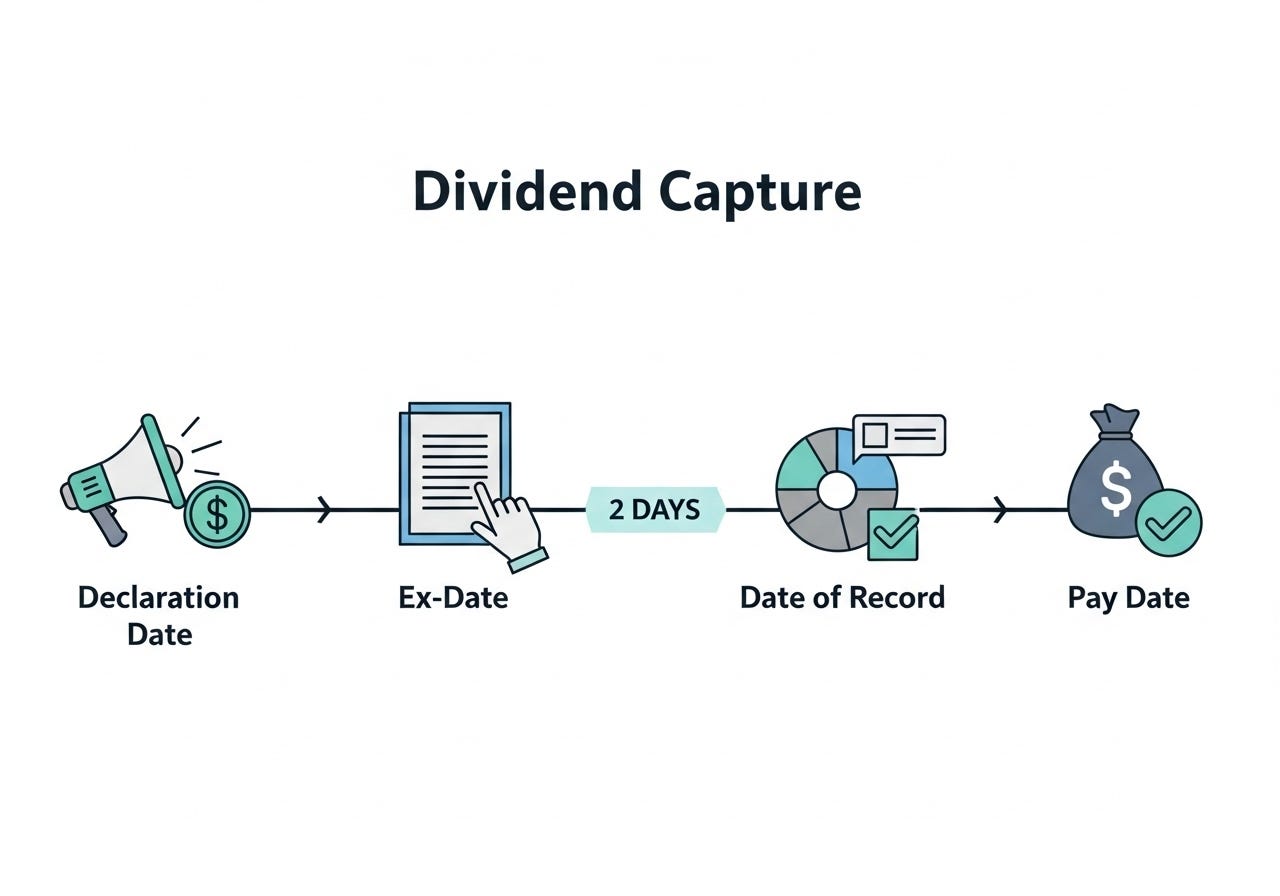
In practice, the strategy consists of buying a stock shortly before the ex-dividend date (the last date available to be entitled to the dividend) and reselling it immediately after having "captured" the dividend. If the post-dividend price does not fall entirely by the amount distributed, the investor realizes a small abnormal gain (given by the dividend received minus the price drop). For example, if a stock was trading at $100 before a $1 dividend payment and opens at $99.20 on the ex-dividend day, the investor who bought at $100 receives $1 in dividends but loses $0.80 in price, resulting in a $0.20 gross profit per share (about 0.2%).
This opportunity exists because, on average, the market does not reduce the price by exactly 100% of the dividend but by a slightly smaller fraction (drop ratio < 1). Several theories explain the phenomenon: partly fiscal effects (investors who tax dividends less than capital gains accept a decline in < dividend), partly microstructure effects (bid-ask spread, opening order of stocks) and supply/demand dynamics around the ex-dividend date. In any case, the recurring empirical result is a small “premium” around ex-dividend dates .
Stock Picking: Which Stocks to Choose?
Not all stocks offer the same opportunities in a dividend capture. Studies indicate that various stock picking criteria influence the outcome:
Dividend Yield and Dividend Amount: Stocks with high dividend yields tend to exhibit more pronounced ex-dividend anomalies. Karpoff & Walkling (1988) found that after the deregulation of NYSE commissions in 1975 (which reduced transaction costs) short-term trading opportunities are found almost exclusively in high-dividend-yielding stocks , while for low-yielding stocks there is no evidence of profit. In other words, short-term traders become marginal investors especially in high-dividend stocks, where the potential gain (in absolute value) is greater. Consistently, a study on the NASDAQ found that the price/dividend anomaly increases as the dividend yield increases: the correlation between the ex-dividend anomalous yield and the dividend is stronger in the quintiles of high-yield stocks. Furthermore, only sufficiently high dividend yields can overcome transaction costs– an intuitive concept also confirmed by theoretical analyses. For example, some source note that if the dividend is small, commissions and trading risks probably cancel out the gains of this strategy.
Capitalization and Liquidity: The size and liquidity of the stock have an impact. Less liquid or small-cap stocks often have wide bid/ask spreads and less competition from arbitrageurs, which paradoxically can leave a higher ex-dividend anomaly (but also more difficult to execute). A study on preferred stocks found that in less liquid stocks the excess ex-dividend returns were significantly positive despite normal volumes, a sign that the price was determined by long-term investors (leaving the "premium" intact); vice versa, in more liquid stocks the anomaly was almost zero and abnormal volumes were observed, a sign of strong short-term trading that arbitrages away the profit. Similar evidence emerges for common stocks: Healy & O'Sullivan (2019) show that less liquid and high idiosyncratic risk stocks exhibit higher abnormal ex-dividend returns (hence more potential “profit” for dividend catchers). This suggests that where it is more difficult or expensive to trade (low volumes, high spreads, high specific volatility) the anomaly persists as a risk/liquidity premium for those who exploit it. Conversely, on heavily traded blue chips , competition among traders and ease of execution tend to eliminate much of the edge.
Sector and Dividend History: While there are no intrinsic “sector” differences documented in the literature, in practice many yield traders focus on traditionally high-dividend and relatively stable sectors (utilities, telecoms, REITs, financials). These companies offer high yields but also an income-oriented following that can impact price behavior. Some studies show that high-dividend stocks generate larger abnormal premiums on average, consistent with the presence of “yield-chasing” investors. In addition, traders often prefer stocks with a long track record of reliable dividends . Adopting qualitative criteria such as sustainable payouts, stable earnings and no risk of dividend cuts can avoid unpleasant surprises (e.g. sudden price drops due to a dividend cut). As one report notes, checking dividend history, payout ratio and financial strength helps select stocks that are less prone to negative surprises post-extay (suredividend.com). In short, a high “quality” of the dividend (solid companies, dividend aristocrats, etc.) reduces the risk that the strategy will fail due to extraordinary events on the stock (cuts, earnings warnings, etc.).
Entry Rules: When to Buy?
The timing of the purchase relative to the ex-dividend date is a key parameter. Variants of the strategy differ on how far in advance to buy the stock before the ex-dividend. Some traders buy the day before (to minimize market exposure), others enter a few sessions early to benefit from possible favorable pre-dividend price movements.
Empirical evidence of pre-dividend “run-up”: Academic studies have documented an anomalous price increase in the days/weeks before the ex-date. Eades, Hess & Kim (1984) were among the first to note a “ run-up ” in prices before the ex-date followed by a “run-down” after. More recently, Hartzmark & Solomon (2013) quantified what they call the “dividend month premium” : stocks tend to outperform during the month in which they will distribute the dividend, and then underperform immediately thereafter. This is because many investors attracted by the dividend accumulate the stock as the ex-date approaches, pushing the price higher (incremental demand for yield ). Consequently, buying a little early can allow you to ride this positive momentum before the dividend. A portfolio that buys all the stocks that will pay a dividend that month at the beginning of the month (financing itself short on the stocks that do not pay) produced excess returns of ~0.4% per month in the tests (link). The intuition is that selling the stock before the ex-dividend date (giving up the dividend but avoiding the decline) can even beat the classic strategy: Hartzmark & Solomon find that “selling before the ex-dividend date can generate higher returns (before costs)”, thanks to the rally induced by “dividend seekers” in the preceding days.
Momentum and technical indicators: To optimize the entry, some traders apply technical analysis. If the price is already rising in the pre-ex sessions (positive momentum), it is a sign that the market is accumulating the stock for the dividend; joining this trend can be advantageous. On the contrary, if the stock is falling before the ex-dividend (negative momentum), the strategy could be risky (the decline could continue and add to the dividend effect). Trading guides suggest using momentum indicators (e.g. RSI, MACD) to evaluate the buying pressure before the ex-dividend, and moving averages to identify favorable short-term trends (suredividend.com). Volume analysis is also useful: increasing volumes as the ex-date approaches indicate growing interest (a good sign for dividend capture). In summary, an ideal entry occurs a few days before the ex-date, when the stock shows relative strength and sufficient liquidity, while avoiding entering too early (prolonged exposure) or on a weak stock that is falling.
Examples of tested entry rules: Some experimental studies (e.g. theses and white papers) have compared different entry windows: 1 day ahead , 5 days ahead , 20 days ahead , etc., with varying results. In an analysis of the Swedish and Dutch markets, strategies with entry at -1 day and -5 days produced similar returns (both very small), while anticipating at -20 or -60 days diluted the advantage (longer exposure reduces the average AR). These results confirm the idea that much of the dividend capture “premium” is concentrated in the days immediately surrounding the ex-dividend date . Entering too early exposes you to prolonged market risks that tend to cause yields to converge toward zero.
Exit Rules: When (and How) to Sell?
The timing of the sale is equally crucial. The goal is to minimize the capital loss related to the dividend, while optimizing the net profit. The main options are: sell on the ex-dividend day (or immediately the day after the opening) or hold for a few sessions waiting for a possible post-dividend price rebound.
Sell immediately vs. wait for recovery: The classic strategy involves selling immediately after collecting the dividend, ideally on the ex-dividend day itself or shortly thereafter, to “exit” the operation as soon as possible. This reduces exposure to the post-dividend “run-down” often observed. In fact, as mentioned, several studies show that after the ex-dividend the stock tends to underperform (the price can continue to fall for a few days when the interest of yield-chasers fades). Holding the stock for a long time after the ex-date risks eroding that small premium earned: for example, Eades et al. (1984) noted negative abnormal returns in the days following the ex-date, suggesting that it is worth closing the position quickly. On the other hand, some traders argue that in some cases the price can partially rebound in the following days, especially if the initial decline was excessive or in the presence of strong fundamentals. Consequently, alternative strategies involve setting a price target : for example, selling only if and when the price rises towards the pre-ex-date level (thus capturing both the dividend and a rebound capital gain). This variant, however, introduces uncertainty (the recovery may not occur) and prolongs the duration of the trade.
Stop-Losses and Trailing Stops: Given the marginal nature of the gains involved, an adverse price move can quickly turn a profitable trade into a losing one. For this reason, managing risk is key. Many traders set very tight stop-losses immediately after the ex-date: for example, if the price falls well below the dividend amount (indicating that other bearish factors are at work), they exit immediately to limit the loss. Some use trailing stops (stops that move with the price) in the few days after the ex-date to protect any small gains in the event of volatility. The idea is to minimize the price loss after cashing in the dividend, making the exit with the least possible price penalty. The literature also emphasizes that the success of the strategy requires accurate exit timing: dividend traders reduce the risk of post-dividend declines by selecting stable stocks and timing the exit with discipline. In practice, setting exit rules in advance (e.g. “sell in any case within X days of the ex-dividend date” or “sell if the price falls more than Y% above the dividend”) helps to prevent the greed to capture even a possible rebound from translating into staying too long in a deteriorating trade.
Entry/Exit Rules Conclusion: Overall, the evidence suggests that the optimal trading window is very narrow around the ex-dividend date . Entering shortly before (1-3 days) and exiting immediately after allows you to isolate the “dividend anomaly” by reducing your exposure to market risk. Any extension of the holding period – before or after the event – tends to reduce or cancel out profits, unless there are particularly favorable momentum conditions.
Return After Costs: Is the Strategy Profitable?
A crucial question is whether, net of commissions, bid-ask spreads and taxes, dividend capture actually generates positive returns. Much of the literature agrees that these are very thin margins , often eroded by transaction costs – especially for individual investors. Here are the key findings from empirical studies:
Importance of Trading Costs: Because abnormal returns per event are very small (often fractions of a percentage point), even modest costs can make the difference between profit and loss. Karpoff & Walkling (1988) found that before 1975 (high fixed commissions) there was no evidence of profitable trading around ex-dates; only after commissions were reduced did traders begin to arbitrage dividends on high-yielding stocks. This indicates that lower commissions have made the strategy just about feasible. Even today, a study has found that in stocks where the bid-ask spread is wider, abnormal ex-dividend returns are higher (because of less arbitrage), while in stocks with narrow spreads the anomaly almost disappears (Dubofski and Kannon (1993)). In practice, transaction costs represent the main limit to the Dividend Capture Strategy: the theoretical profit exists, but it is often absorbed by spreads and commissions during the purchase/sale phase. A Minneapolis Fed analysis summed it up well: “dividend capture is attractive only if the dividend yield is high enough to cover transaction costs .” For example, capturing 1-2% dividends with total round-trip costs of 0.5% could leave a positive margin. Capturing 0.5% dividends with the same costs almost certainly leads to a net loss.
Evidence of Profit for Institutional Investors: A recent and large study by Henry & Koski (2017) analyzed 25,000 dividend capture transactions executed by US institutional investors between 1999 and 2007. The results are revealing: before trading costs, the transactions produced a small average profit (e.g. about +0.405% for equally-weighted transactions on average). After subtracting commissions and market impacts , the profit dropped dramatically but remained statistically positive in some cases (e.g. ~0.24% for optimized trades). This means that, at least for some institutional players with efficient execution, the strategy can generate a significant excess return even after costs, albeit small (order of a few “basis points” per trade). In particular, Henry & Koski show that only institutions with high execution skill (ability to minimize slippage, spreads and commissions) obtain positive returns; for the “less skilled” institutions, that margin of 20-40 basis points evaporated making the trade a loss.An estimated ~0.40% difference in returns between the best and worst performing fund managers on these trades. In essence, “only investors with significant operational skill are able to achieve abnormal profits from dividend capture”. This explains why many mutual funds or hedge funds do not adopt this strategy en masse: the gain is small and reserved for those who can significantly contain costs (e.g. high-speed trading desks, discount brokerages, large size to dilute fixed costs, etc.).
Hedged strategies: A variant to improve the return profile is to hedge the market risk during the trading window – for example by shorting index futures or using options – so as to isolate (almost) only the dividend effect. Studies such as Dubofsky (1987) and Kannan (1993) have explored “hedged dividend capture” , finding encouraging results: hedging can reduce volatility/risk by more than 50% and leave the small abnormal return intact, improving the risk-return profile. In particular, Kannan (1993) reported that, on a portfolio of US stocks, a dividend capture strategy combined with market coverage generated slightly higher returns than simple buy-and-hold, even after transaction costs. These results imply that the dividend capture premium could be seen as a form of quasi-risk-free arbitrage once the directional risk is neutralized – at least for sufficiently liquid securities – although in practice there remain specific risks and hedging costs to be considered. The presence of a “premium” that can be captured even after hedging is consistent with the interpretation that the abnormal ex-dividend yield is a compensation for those who provide liquidity in that market (absorbing the selling/buying pressure around the ex-dividend date). In other words, dividend-capturing traders would be collecting a risk premium for the arbitrage service they perform, rather than a free lunch.
Individual investors: For retail traders, the evidence is less favorable. In addition to commissions (often higher in proportion) and spreads, there is the tax issue: in the US, dividends collected on positions held for less than 60 days do not benefit from the reduced rate on “qualified dividends” . This means that an individual investor who does dividend capture ends up paying an ordinary income tax rate (higher) on the dividend, while if he had obtained the same gain as capital gains he would pay a lower tax (if the security is held > 1 year). This penalizing tax treatment “eats up” much of the advantage for small investors, as also underlined by practical commentators. In fact, “this strategy could be tax-neutralized” if done outside of tax-sheltered accounts. In short, for most private investors, dividend capture does not beat costs and taxes : studies and simulations show microscopic gross returns that become negative once commissions, bid-ask spreads and taxes are included. Not surprisingly, traditional investment manuals and popular articles (Investopedia, Forbes, etc.) conclude that “dividend capture rarely works for most investors” because markets are efficient enough to neutralize easy gains in the absence of some competitive advantage.
Below, in Table 1 , we report a summary of some key studies on the subject, with the related methods and conclusions on the strategy's performance (after costs).
Market Conditions: When Does It Work Better or Worse?
Dividend capture performance is not uniform in every market context . The literature identifies specific conditions in which the strategy is more effective (or fails):
High Volatility Phases or Bear Markets: During periods of financial stress or high uncertainty, many investors tend to take refuge in high dividend stocks perceived as “safer” (e.g. utilities, consumer staples). This hunt for yield can accentuate the phenomenon of dividend underpricing. Hartzmark & Solomon note that the dividend month premium was more pronounced in periods of high volatility. In such phases, yield chasers push up pre-detachment prices, creating greater distortions (and therefore greater potential profit for those who arbitrage them by selling before or immediately after the detachment). Henry & Koski also find that abnormal returns around detachments are not uniform over time: institutional investors tend to concentrate capture operations in certain windows of opportunity, rather than making them consistently– which suggests that in certain market contexts (e.g. widespread crashes where dividends become relatively more attractive) profit opportunities increase.
Periods of “Dividend Scarcity”: A special case is when few companies pay dividends while others suspend them. This is what happened for example during the initial phase of the COVID-19 pandemic (2020), in which many companies cut or cancelled their dividends. A study of European markets in 2020-21 showed that in that “abnormal” period, abnormal ex-dividend yields were significantly higher than normal , as investors chasing dividends fought over the little that was left. The phenomenon was amplified for high-yield securities and in markets where short-selling bans were in place. This indicates that in conditions of reduced dividend supply , paradoxically the capture strategy could have generated more significant returns (those who managed to trade on those few detachments benefited from larger anomalies). On the contrary, in periods in which "everyone" distributes dividends normally, the premium tends to be more contained and distributed.
Tax Regime: The differences in taxation between dividends and capital gains over time have affected the success of the strategy. In the US, before 2003 dividends were taxed more heavily than capital gains; this implied lower drop ratios (marginal investors with high tax rates claimed larger discounts). After 2003 (15% rate aligned with capital gains for qualified dividends ), a reduction of the anomaly could be expected. In practice, however, studies such as Michaely (1991) on the 1986 Tax Reform and others did not find drastic changes in the post-reform ex-dividend behavior. This suggests that in the modern period the role of individual tax clienteles has diminished, leaving space mainly for institutional traders (often tax-exempt or tax-deferred) in determining ex-day prices. Therefore, in markets with exploitable tax advantages (e.g. foreign investors exempt from US dividends, or companies that enjoy a dividend received deduction ), the strategy may be more attractive. Conversely, for an investor subject to full immediate taxation, the after-tax may cancel out the after-cost .
Interest Rates and Relative Attractiveness: In very low interest rate environments (e.g. the 2010-2019 decade), stock dividends become relatively more attractive than bonds, inducing more investors to move based on coupons. This could fuel more dividend run-up . Indirect studies confirm this: for example, in periods of turbulence or recession (when rates fall and sources of income are sought) high-dividend strategies outperform the market.Conversely, with rising rates and many yield alternatives, it is plausible that the focus on dividends will decline and with it the exploitable inefficiencies. In any case, the literature specifically on interest rates and dividend capture is sparse; we can infer that the yield differential plays a role – the more attractive dividends are vs. other asset classes, the more investors will chase them and create exploitable price movements (up to a point where too many arbitrageurs cancel them out).
Conclusions
The Dividend Capture Strategy has been the subject of extensive empirical testing, with mixed but instructive results . In general:
The phenomenon exists: the stock price typically does not fall entirely by the amount of the dividend on the ex-dividend day, generating a small anomalous return available. This is confirmed by decades of studies on various markets and periods.
Thin and conditional margin: that premium is small (often a few cents per share, or a few basis points in percentage) and is easily absorbed by transaction costs, slippage and – for private individuals – taxation. Most academic analyses find no significant net profits for the average investor once costs are taken into account: unless special conditions are met, the strategy tends to offer zero or negative returns after costs.
For efficient (or lucky) traders only: Some institutional investors with superior execution capabilities have demonstrated that they can extract value from this strategy on a consistent basis. This requires minimizing costs per trade (often through high volumes, low-cost institutional brokerages, trading techniques that reduce market impact) and selectively exploiting the most favorable situations (right stocks, right timing). In practice, the strategy is profitable only “in the right hands” , while for an investor without an edge it can be a zero-sum game or worse .
Importance of selection and timing rules: Studies show sensitivity to parameters. Choosing high dividend stocks (preferably with low tax base for the arbitrageur, and low competition scenario) is almost a prerequisite to see any margin. Delaying entry or exit dilutes profits – “time is money” is a literal term here. Sophisticated strategies, such as spotting pre-ex momentum patterns or technical conditions, can improve your odds of success (avoiding entries into weak or illiquid stocks, for example).
Risks and careful management: It should not be forgotten that this strategy, although market-neutral in intention, exposes to non-negligible market and specific risks: negative news about the company just when you are holding the stock can cause a much greater drop in the dividend (thus nullifying the trade). Furthermore, the concentration of purchases and sales in narrow windows can amplify volatility. The use of hedging and stop-loss is essential if you want to systematically pursue dividend capture. As highlighted, with adequate coverage you can reduce volatility by more than half while maintaining some extra yield.
In conclusion, the Dividend Capture Strategy in the US stock market has historically proven to be a challenge : it is not the golden goose that it might seem in theory, since fairly efficient markets have made the advantages small and have reserved those few to the most prepared players. In particular market conditions - the right stocks, high volatility or reduced competition - there is evidence of positive returns net of costs, but in most cases these returns have been absorbed by costs and risks. The literature therefore suggests that the strategy really works only in specific niches , for example for very cost-conscious proprietary desks or in transitory mispricing environments, while for ordinary investors the game is often “not worth the candle” . As Henry & Koski effectively summarized, dividend capture is not a source of abundant alpha, but it can offer a modest opportunity to investors with a high degree of execution skill.
About this Post
This post is the result of research carried out with the support of AI deep research tools, and I published it, after review and verification, only as a reminder for myself. Since it took me a long time to finalize it, I thought it would be a shame to let it die after just one reading, so I am making it available to anyone who is interested. Any comments or further contributions useful for deepening the topic are welcome.